
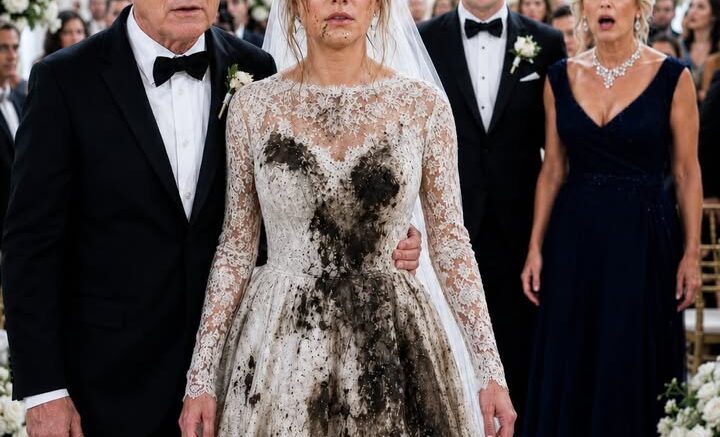
The morning of my wedding was supposed to be a symphony of white lace and soft light, but it ended in a silent scream. Three hours before I was meant to walk down the aisle to marry Daniel Whitmore, I walked into the bridal suite to find my gown transformed. My mother-in-law, Eleanor, had visited the room in secret, leaving behind a trail of destruction that smelled of malice and rot.
She had poured a bucket of foul, black garbage water directly over the ivory silk bodice. The liquid had seeped into the delicate fibers, blooming like a dark bruise across the chest and dripping onto the polished hardwood. It was a calculated act of war, designed to humiliate me before the most influential families in the state.
Clutched in the folds of the ruined lace was a small, cream-colored note. I picked it up with trembling fingers, recognizing the elegant, sharp cursive immediately. It contained only three words: “Know your place.” For ten long seconds, I stood in a vacuum of silence, staring at the wreckage of my dreams.
The dress hung from the mahogany closet door like a wounded ghost. Every pearl button I had carefully chosen and every hand-sewn sleeve was now a testament to Eleanor’s hatred. My maid of honor, Tessa, stood behind me, her hands flying to her mouth in a stifled gasp of horror.
“Maya… who would do something like this?” she whispered, her voice cracking. I didn’t need to answer; the handwriting spoke for itself. Eleanor Whitmore had spent two years treating every insult as if she were writing a thank-you card, and this was her final masterpiece of cruelty.
I reflected on the two years of subtle psychological warfare I had endured. She had called me “sweetheart” when she meant “servant.” She had asked if my hardworking father was “comfortable” paying for his own suit, implying he was beneath her tax bracket. She told her high-society friends I was “pretty enough, for someone without background.”
Whenever I sought refuge in Daniel, my fiancé, he would simply kiss my forehead and offer a hollow defense. “She’s just protective, Maya,” he would say, dismissing the sharp edges of his mother’s tongue. I realized then that “protective” was simply the word he used for cruelty when it wore a strand of pearls.
Tessa reached for her phone, her face flushed with indignation. “We’re calling security right now. We’re calling the police. This is vandalism, Maya. You can’t let her get away with this,” she insisted, but I reached out and gently lowered her hand.
“No,” I said, my voice surprisingly level. The shock was receding, replaced by a cold, crystalline clarity that I had never felt before. I looked at myself in the full-length mirror, seeing a woman whose hair was pinned perfectly and whose makeup was a flawless, expensive mask.
The woman staring back at me did not look broken or defeated. She looked like someone who was finished waiting for permission to exist. The fear that had lived in my chest for months evaporated, leaving behind a sharp, jagged sense of purpose.
My father knocked softly on the door and stepped inside, his smile fading instantly as he saw the dress. His face cycled through a dozen emotions—confusion, horror, and then a deep, simmering rage. “Maya, honey,” he started, stepping toward the ruined silk.
“I’m wearing it,” I told him, cutting off his protest before it could form. I saw the way his eyes searched mine for a sign of hysteria, but he found only resolve. I was not going to hide the truth of this family anymore.
Be the first to comment on "The Stained Silk: A Wedding Day Defiance"