
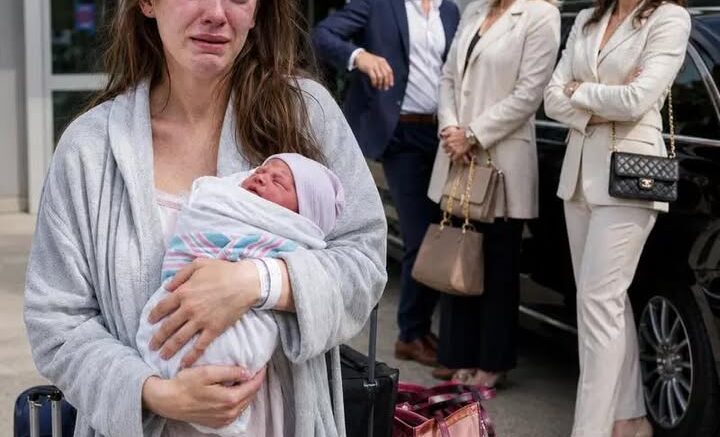
The sun was blindingly bright as I stood on the sterile concrete curb of the maternity ward. My discharge papers were clutched in a trembling hand, and my newborn daughter was a warm, fragile weight against my chest. The physical toll of labor still thrummed through my body, every step a reminder of the stitches that were barely twenty-four hours old. I looked at my husband, Daniel, expecting him to reach for the diaper bag or offer me a supportive arm. Instead, he stood there in a crisp, cream linen shirt, adjusting his designer sunglasses as if he were posing for a magazine cover.
Beside him, a sleek black Maybach purred, its engine idling with a low, expensive hum. His mother, Marlene, sat in the front passenger seat, her gaze fixed forward, while his sister, Ava, was already in the back, meticulously applying a fresh coat of lipstick. The trunk was already loaded with leather suitcases, none of which belonged to me or the baby. The air smelled of expensive cologne and the cold realization that I was no longer part of the itinerary.
“We can’t miss the flight, Liora,” Daniel said, his voice devoid of the tenderness one might expect for a new mother. He checked his Patek Philippe with a sharp, impatient flick of the wrist. “The private jet leaves for Maui in ninety minutes. The pilot has a strict window, and I’ve already pushed the departure back once.” I stared at him, my voice caught in my throat. I had just brought his child into the world, and he was discussing flight windows.
“You’re leaving now?” I finally managed to whisper. The absurdity of the moment felt like a fever dream. I looked at the hospital entrance, then back at the luxury car that was meant to take us home as a family. My mind struggled to process that he was actually standing there, dressed for a tropical vacation, while I was still wearing a hospital ID bracelet and orthopedic socks.
Daniel sighed, a sound of pure exasperation, as if my recovery were a personal affront to his schedule. “Don’t start with the theatrics. My mother has been looking forward to this retreat for months, and Ava needs a break from the city. You and the baby need rest, which you can do perfectly well at the house. There’s no point in all of us sitting around a nursery when we could be productive.”
Marlene chose that moment to lower her window, the cool air-conditioning from the car venting out into the humid afternoon. She didn’t look at the baby. She didn’t even look at me. “She can simply call a car service, Daniel,” she said, her voice dripping with calculated indifference. “Women have been giving birth for millennia without the need for a parade. Modern medicine has made you soft, Liora.”
Ava chimed in from the back seat, her laughter light and cruel. “Honestly, Liora, look at you. Hawaii is for bikinis and mai tais, not for leaking milk and crying infants. You’d be miserable anyway. We’re doing you a favor by letting you stay behind in the quiet.” She then turned back to her phone, snapping a selfie with the airport-bound luggage visible in the frame, captioning it with something about ‘Island Vibes.’
I looked down at my swollen feet, shoved into cheap plastic slides, and then at the tiny, sleeping face of my daughter. I felt a surge of protectiveness so fierce it eclipsed the pain in my abdomen. Daniel leaned in, his voice dropping to a sharp, commanding tone. “I’ve already settled the hospital bill, so don’t act like I haven’t provided for you. Just get a ride, go home, and don’t blow up my phone. I need peace this week.”
In that moment, something profound shifted inside me. The woman who had spent three years trying to earn the approval of this family—the woman who had quietly endured their snide remarks about her ‘orphan’ background and her ‘lack of pedigree’—simply ceased to exist. The silence that followed wasn’t one of defeat; it was the silence of a predator who had finally seen the opening it needed. I didn’t argue. I didn’t beg. I just watched.
“A good wife knows the value of gratitude,” Marlene added, her eyes narrowing as she signaled Daniel to get in. He didn’t offer a hug or a kiss to his daughter. He just stepped back, adjusted his collar, and climbed into the driver’s seat. He didn’t look back as he shifted the car into gear. The Maybach pulled away smoothly, leaving a faint scent of exhaust and the bitter taste of betrayal in the air.
I stood there for a long time, the silence of the hospital driveway ringing in my ears. A nurse eventually emerged from the sliding glass doors, her expression transitioning from professional calm to utter horror as she realized I was standing there alone. “Ma’am? Where is your ride? Do you need me to call your family?” she asked, reaching out to steady me. I looked at her, and for the first time in three years, I felt completely light.
“No,” I replied, my voice steady and cold. “I don’t have a family here. But I do have a phone.” I allowed her to lead me back into the lobby, not because I was weak, but because I needed a quiet place to work. As I sat in the plastic waiting room chair, I didn’t call a taxi. I called Ms. Hart, the lead counsel for Wren Capital, the private equity firm that the world—and my husband—believed was a faceless monolith.
Be the first to comment on "The Price of Abandonment: Why My Billionaire Husband Regrets Leaving Me at the Hospital"