
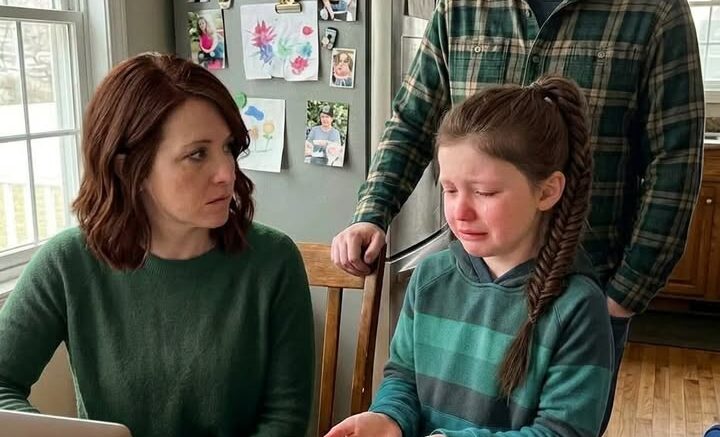
The silence in my kitchen was heavy, broken only by the rhythmic ticking of the wall clock and the soft sound of my daughter, Mia, shifting in her chair. At twelve years old, Mia had always been a quiet observer, a gentle soul who sought to please everyone around her. But that afternoon, something was different. She sat with her palms pressed firmly against the wooden table, as if she were trying to hide her hands from my sight. I stood in the doorway, watching the way her shoulders hunched, sensing a weight on her that no child should ever have to carry.
“Hey,” I said softly, stepping into the room. “What happened today? You seem exhausted.” She didn’t look up immediately, her eyes fixed on a knot in the wood of the table. She blinked rapidly, clearly choosing her words with a caution that felt unnatural for her age. When she finally spoke, her voice was barely a whisper. “I just worked,” she said, her tone defensive yet fragile. My heart skipped a beat as I moved closer, sensing the tension radiating from her small frame.
“Worked where?” I asked, my voice steady despite the growing knot of concern in my stomach. She finally lifted her hands, and I saw the telltale signs of manual labor: the skin was red, raw, and angry from scrubbing. She winced as she rubbed one wrist, trying to soothe the ache. “Mrs. Novak’s house,” she explained. “All afternoon. She gave me twenty dollars.” I froze, trying to process why my daughter felt the need to spend her Saturday scrubbing floors for a neighbor.
“Mia,” I asked, kneeling beside her chair, “why did you need money so badly?” She looked down again, her voice becoming even tinier. “It’s not for me. It’s for Sophie.” Sophie was my sister Heather’s daughter, the golden grandchild whom my parents treated like royalty. Every milestone for Sophie was a grand production, while Mia’s achievements were often met with a polite nod and a quick change of subject.
“They’re collecting money for her birthday,” Mia whispered, her eyes filling with tears. “Everyone is.” When I asked how much they had demanded from a twelve-year-old, the answer nearly knocked the breath out of me. “One hundred dollars,” she said. There was no version of love or family values where one child should have to scrub a neighbor’s house until her hands bled just so another child could receive a more expensive gift.
I felt a cold, sharp weight settle in my chest as the realization dawned on me. “Who told you that you had to give that money, Mia?” I asked, my voice dropping an octave. She swallowed hard, her voice trembling. “Grandma.” She said it as if my mother’s word was an absolute law, a command that could not be questioned or disobeyed. I felt a surge of protective fury, but I kept my exterior calm for my daughter’s sake.
“What exactly did she say to you?” I pressed, wanting to know the full extent of the manipulation. Mia let out a shaky breath, a single tear escaping and rolling down her cheek. “She said if I didn’t contribute, I shouldn’t expect to be treated like family.” For a moment, the world seemed to stop. No grandmother should ever weaponize a child’s sense of belonging to extort money, yet here we were.
My daughter’s hands were sore, her spirit was flagging, and worst of all, she actually believed the lie. She believed that her place in our family was conditional, a commodity that had to be purchased with labor and cash. “I didn’t want to ask you,” she rushed to explain, sensing my anger. “I thought it had to be my money. If you paid, it wouldn’t count. I broke my piggy bank, but it still wasn’t enough.”
I sat beside her and pulled her into a hug, feeling the tension slowly leak out of her. “You did nothing wrong, Mia,” I whispered into her hair. “I shouldn’t have told you,” she sobbed, and that admission nearly broke my heart. She had been conditioned to suffer in silence, to protect the very people who were exploiting her. It was a cycle I knew all too well, one that had defined my own upbringing.
I walked into the living room, my phone gripped tightly in my hand. I wasn’t going to scream; I was past the point of explosive anger. A small, foolish part of me still hoped my mother would deny it, that she would tell me Mia had misunderstood a joke. But when she answered the phone, her voice was light and cheerful, completely devoid of guilt. “Hi, sweetheart. Everything okay?” she asked.
“Mom,” I said, my voice like flint, “Mia told me you asked her for a hundred dollars toward Sophie’s birthday gift.” There was a brief pause on the other end of the line—not a pause of shock, but one of calculation. “Yes,” my mother said finally. “That’s right. She’s twelve, Eleanor. Twelve-year-olds can work. They can learn responsibility and the value of supporting their kin.”
My pulse pounded in my ears as I asked the final, damning question. “Did you tell her that if she didn’t pay, she shouldn’t expect to be treated like family?” My mother didn’t even hesitate. “Yes. She needs to learn what family means. Responsibility. Values.” She spoke the word ‘values’ as if my daughter’s aching hands were a righteous sacrifice. Something inside me went completely, terrifyingly still. “Okay,” I said, and before she could respond, I ended the call.
Be the first to comment on "The Price of Belonging: Why I Finally Cut Off My Entitled Family"