
It has been twenty-two years since my life was redirected by a note scrawled on the back of a gas receipt. At twenty-seven, I was a man of simple ambitions, living in a modest apartment above the hardware store where I spent my days. My bank account held a meager three hundred and twelve dollars, and my understanding of the world was limited to the shelves I stocked and the quiet life I led. That all changed on a humid Tuesday evening when the sound of a departing engine drew me to my porch.
There, sitting in the fading light, were three car seats and a single, overflowing diaper bag. My brother, shattered by the death of his wife only eleven days prior, had reached his breaking point. The note he left was brief, desperate, and devastating: “I’m sorry, Noah. I can’t do this.” In that instant, the silence of the street was replaced by the synchronized cries of six-month-old triplets, and the trajectory of my existence was altered forever.
I remember the weight of the panic that settled in my chest as I looked down at Ava, Claire, and June. I was a bachelor with no knowledge of infant care, let alone the endurance required to raise three children simultaneously. My neighbor, watching the scene unfold from her porch, voiced the thought I was too terrified to articulate: “You can’t raise three babies alone, Noah. It’s impossible.”
She was likely right. By every logical metric, I was ill-equipped for the task. Yet, as I reached down to adjust one of the blankets, the smallest triplet—June—wrapped her tiny, fragile fist around my index finger. The grip was firm, an instinctive anchor in a world that had just abandoned her. In that moment, the phone call to social services I had been planning to make simply evaporated. I couldn’t let go.
So, I stayed. I became “Uncle Noah” by title, but I became a father by necessity and devotion. The years that followed were a blur of sleepless nights and the steep learning curve of domesticity. I learned to warm bottles to the perfect temperature, to navigate the aisles of grocery stores with a triple-stroller that felt like a semi-truck, and to survive on four hours of interrupted sleep.
Money was always tight, a constant shadow over our small home. I took every double shift the hardware store offered, and when that wasn’t enough, I picked up odd jobs fixing fences and painting houses on my weekends. My own dreams—traveling, finding a partner, building a career in architecture—were quietly shelved. They weren’t discarded with resentment, but rather traded for something that felt infinitely more urgent.
I missed out on the typical milestones of a man in his thirties and forties. While my peers were attending weddings and buying vacation homes, I was sitting through elementary school science fairs and trying to figure out how to braid hair without it looking like a bird’s nest. I was the only man at the PTA meetings, often covered in a light dusting of sawdust or flour, feeling like an outsider in a world of organized suburban parenting.
There were phases, of course, where the gratitude was absent. The teenage years brought a collective rebellion that tested every ounce of my patience. There were months where it seemed all three of them hated me in unison, slamming doors and lamenting the fact that their lives were governed by a tired man who smelled like WD-40. I took the hits, stayed steady, and kept the fridge full.
I never married. It wasn’t that I didn’t want to, but the logistics of my life left little room for a partner. Who would want to step into a ready-made family of four with a man who was always one emergency away from exhaustion? I accepted the solitude as the price of their stability. Someone had to stay, and I had decided long ago that I would be the one who never left.
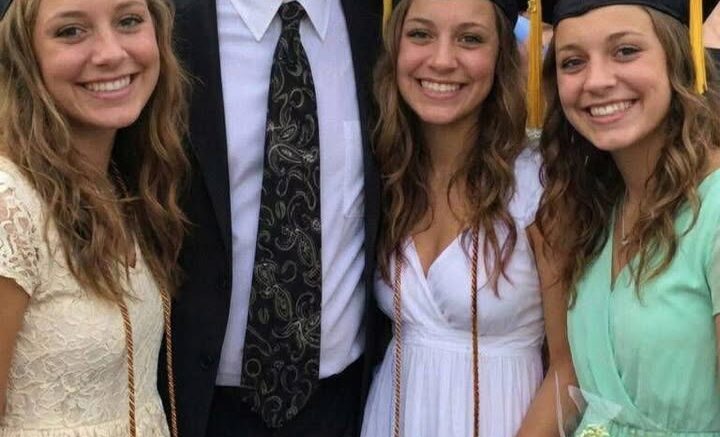
By the time their college graduation arrived, I was a different man. My beard had turned a permanent shade of slate gray, my right knee ached with every step due to years of heavy lifting, and my hands were calloused. Standing in the crowd at the university stadium, I felt a profound sense of completion. I had gotten them to the finish line, or rather, the starting line of their own lives.
Watching them walk across the stage was like watching a montage of twenty-two years flash by in high definition. Ava went first, her eyes already welling with tears before her name was even called. She was the sensitive one, the artist who saw the world in colors I didn’t have names for. When she took her diploma, I felt a lump form in my throat that I couldn’t swallow away.
Claire followed, waving at me with the same unbridled enthusiasm she had shown at her second-grade dance recital. She was the firecracker, the one who kept us all laughing when the bills were high and the spirits were low. Finally, June walked across. She was the serious one, the one who had held my finger all those years ago. She carried herself with a gravity that suggested she understood the weight of the day more than anyone else.
Be the first to comment on "A Legacy of Sacrifices: The Note on the Gas Receipt"