
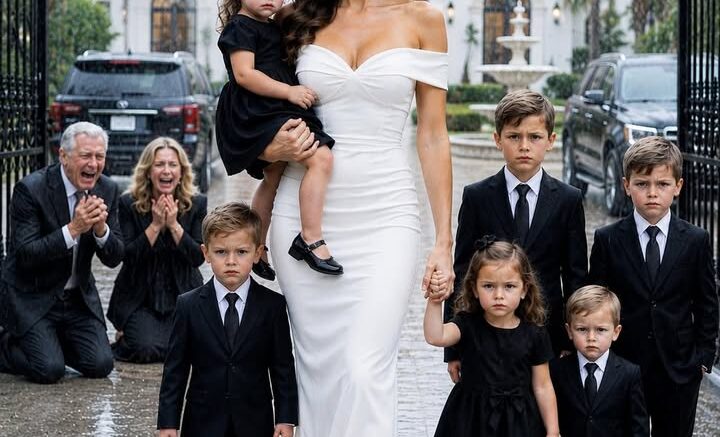
The night air in Pine Valley was thick with the scent of wet earth and the metallic tang of an approaching storm. Patrick Callahan stood on the porch of the sprawling estate, his silhouette framed by the warm glow of a chandelier that now felt like a taunt. For fourteen years, I had walked those halls as a wife and mother, yet in a single stroke of cruelty, the doors were barred against me.
Patrick’s words landed like cold stones against my heart. It was nearly midnight, and the rain had begun to fall in earnest, rattling against the ornate iron gates that separated the elite from the unwanted. I stood on the slick pavement, my eleven-month-old daughter, Sophie, pressed tightly to my chest to shield her from the wind.
Behind me, my other five children huddled together, their small frames shivering under the weight of school backpacks and two black trash bags. Those bags contained the sum total of our lives, or at least what my mother-in-law, Margaret, deemed worthy of keeping. Everything else we owned was now locked behind the deadbolts of a house that had been my home for over a decade.
My husband, Andrew, had been laid to rest only eight days earlier. The grief was still a physical weight in my lungs, a suffocating pressure that made every breath a battle. He had fought a long, grueling illness, and I had spent months watching him fade away in a sterile hospital bed while his parents calculated the cost of his care.
During those final months, Patrick and Margaret rarely visited for comfort. They came to discuss bills, to argue over medical directives, or to fret about how a dying son might impact the family’s social standing. Now that he was gone, they had wasted no time in cleaning the slate—and that meant removing the woman they never truly accepted.
“Patrick, please,” I said, my voice trembling but not breaking. “They are your grandchildren. They have just lost their father. This was Andrew’s home, and it is their home too. You cannot do this in the middle of a storm.”
Margaret stepped into the doorway, her presence as sharp and cold as a winter frost. Her makeup was immaculate, not a hair out of place despite the humidity, and an expensive cashmere shawl was draped elegantly over her shoulders. She looked at us not with pity, but with a profound sense of triumph.
“It was Andrew’s because we allowed him to have it,” she said, her voice dripping with disdain. “But you never belonged here, Cynthia. A girl from a neighborhood like yours doesn’t become a Callahan just by wearing a ring. You were a temporary fixture, and your time has expired.”
My oldest son, Benjamin, who was only thirteen but possessed his father’s quiet strength, stepped forward. His eyes were red and swollen, though not from the cold. He was vibrating with a protective rage that no child should ever have to carry. “My dad said Mom would stay here with us,” he shouted over the rain. “I heard him tell the doctors!”
Patrick’s reaction was instantaneous and violent. He raised his hand and struck Benjamin across the face. The sound of the blow echoed against the metal gates, a sharp crack that seemed to silence the very thunder above us. Benjamin stumbled back, his hand flying to his reddened cheek.
Something inside me, a dam that had held back years of swallowed insults and quiet endurance, finally cracked. The fear that had paralyzed me for the last hour evaporated, replaced by a white-hot clarity. I felt the weight of my children’s futures resting entirely on my shoulders, and I realized that silence was no longer an option.
“Don’t ever touch my son again,” I said, stepping closer to the gate, my eyes locking onto Patrick’s. The baby stirred against me, and I felt the heat of her fever, a reminder of the stakes at hand. Patrick didn’t flinch; instead, he let out a dry, mocking laugh that sent chills down my spine.
Be the first to comment on "The Rain at Pine Valley: A Widow’s Stand Against a Dynasty"