
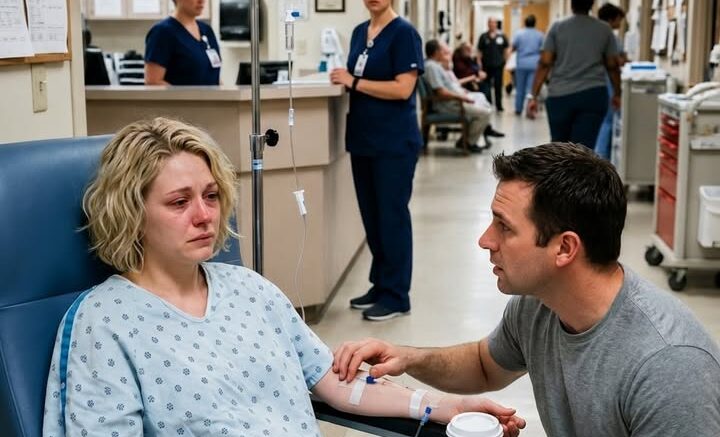
Two months after our divorce was finalized, I found my ex-wife sitting alone in a sterile hospital corridor. The moment I recognized her, the carefully constructed walls of my new, independent life didn’t just crack—they shattered. The hallway was a sensory assault of antiseptic odors, burnt coffee, and that specific brand of refrigerated air that hospitals pump through vents regardless of how many patients are shivering beneath thin, industrial blankets. Somewhere in the distance, a monitor chirped a rhythmic, mechanical heartbeat, punctuated by the occasional squeak of a cart wheel against the high-gloss floors.
I hadn’t come there to see her. I was visiting my best friend, David, who was recovering from a routine surgery. I was moving through the world with the practiced numbness of a man who believed he had successfully closed a chapter. I never expected to see Emily, at least not in this capacity. Seeing her there, stripped of the context of our shared home and the familiarity of our old life, was like seeing a ghost in broad daylight.
She was tucked into a corner near the internal medicine wing, appearing almost swallowed by a pale blue hospital gown that hung loosely off her frame. Her hands were folded neatly in her lap, a posture that suggested she was trying to take up as little space as possible in a world that had already taken so much from her. Her eyes were fixed on a point in the distance, vacant and weary under the unforgiving glare of the overhead fluorescent lights. For a long, agonizing second, I forgot how to perform the simple act of breathing.
My name is Michael. I am thirty-four years old, a man whose life could be described as aggressively ordinary: a desk job, a rented apartment, a sedan with a dent in the rear bumper, and a narrative I kept repeating to myself—that I was finally back in control. Emily and I had been married for five years. To the casual observer, we were the picture of stability. We had the quiet house, the Sunday grocery rituals, and the shared silence of morning coffee. Emily’s love wasn’t a loud, performative thing; it was found in the warmth of leftovers and the way she always checked if I’d eaten, even when she was exhausted.
We started with the same ordinary dreams everyone else has. We wanted a small house with a real driveway, a backyard where the grass was perpetually cluttered with plastic toys, and the joyful chaos of children. But instead of a nursery, we got three years of waiting and two devastating miscarriages. We were left with a heavy, suffocating silence that neither of us was equipped to carry. The first loss broke her heart; the second seemed to break her spirit, causing her to retreat into a place I couldn’t reach.
I changed during that time, too, though I hate admitting how easily I rebranded my avoidance as ‘responsibility.’ I stayed late at the office, obsessively answering emails that could have waited until morning. I told myself that the overtime was necessary for our future, but in reality, I was just terrified of the heavy conversations waiting for me at the kitchen table. Grief doesn’t always demolish a home in a single storm; sometimes, it just slowly unfastens the screws until the structure begins to lean, and no one wants to be the one to admit it’s falling.
By the time April arrived, we had become two weary strangers navigating the same floor plan. There were no cinematic screaming matches, just the slow erosion of our bond through petty arguments over laundry and dinner. These disagreements always ended the same way: one of us retreating to the bedroom while the other stared into the kitchen sink, hoping the dirty dishes might offer an explanation for how we had failed so spectacularly.
On a Tuesday night in April, at exactly 10:42 p.m., the tension finally snapped. After a hollow argument that left us both standing in the kitchen with empty expressions, I voiced the thought I’d been harboring like a secret weapon. I told her that maybe we should get divorced. She didn’t react with fire or fury. She simply looked at me and asked if I had already made up my mind. I didn’t have the courage to lie, and my silent nod was the final blow to our five-year history.
Her lack of resistance was, in many ways, more painful than a fight would have been. She didn’t beg, she didn’t cry out; she simply walked to the bedroom and began packing her life into the gray suitcase we had bought for a weekend getaway back when we still believed we could fix anything. The legal process moved with a cold, terrifying efficiency. There were forms, digital signatures, and a finality that felt entirely too small for the amount of life we had shared together.
After the split, I moved into a bachelor apartment that felt more like a waiting room than a home. I lived a minimalist, solitary existence defined by microwaved meals and the blue light of the television. I told myself I was doing the right thing, using that justification like a thin blanket against the cold reality of my empty rooms. I missed the warm light in the kitchen and the sound of her footsteps, but I refused to acknowledge the depth of the void I had created.
Two months passed in this self-imposed exile. Then came the Thursday in June when David sent a casual text from his hospital bed. I stopped at the gift shop for a mediocre cup of coffee and made my way toward the recovery wing, my mind occupied with trivial thoughts. I passed the reception desk and the American flag, noting the sterile details of the environment as I searched for David’s room. That was when I saw the figure in the blue gown.
At first, she was just a silhouette at the edge of my periphery—a woman hunched over by an IV stand. Her hair, once long and chestnut, had been cut into a short, functional style that made her look vulnerable and exposed. When she turned her face toward the light, the coffee cup in my hand buckled under the sudden pressure of my grip. It was Emily. My ex-wife, the woman I had walked away from, was sitting alone in the internal medicine ward, looking like a fragment of her former self.
Be the first to comment on "The Ghost in the Hospital Corridor: A Story of Silence and Second Chances"