
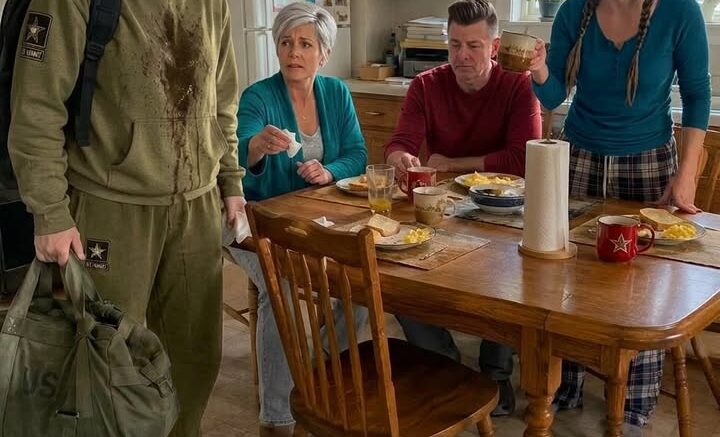
I returned home expecting ten quiet days of reprieve before reporting back to the grind at Fort Carson. My mental checklist was simple: sleep in until the sun hit the floorboards, savor my mother’s home-cooked meals, and rediscover the familiar comfort of the old kitchen table. I wanted to forget, if only for a moment, the rigid military schedules, the accountability reports, and the relentless logistical puzzles that defined my life in the Army. I arrived seeking peace, believing that the four walls of my childhood home were a sanctuary from the complexities of the outside world.
However, reality has a cruel way of dismantling expectations. Less than forty-eight hours into my leave, I found myself sitting in the sterile environment of an urgent care clinic. The sharp scent of antiseptic replaced the aroma of breakfast, and a nurse leaned in to examine the blistering burn on my face. As she worked, I struggled to find the words to explain how a simple morning meal had escalated into a physical assault. It was the moment I realized that the people I called family were no longer my allies.
The disaster took root in my parents’ kitchen, a room that seemed frozen in time. The same oak table stood as the centerpiece, its surface scarred by decades of use. Chipped coffee mugs lined the cabinet shelves like old soldiers, and the television near the refrigerator blared local news, providing a white-noise backdrop to our lives. Outside, a faded American flag hung limp from the porch planter. Everything looked the same, yet the atmosphere was charged with a tension I hadn’t anticipated.
When I walked downstairs that morning, my sister, Britney, was already awake and seated at the table. In our house, that was the first red flag. Britney was never an early riser unless she had a specific agenda or a desperate need. She sat there, nursing a mug of coffee, her eyes tracking my movements with a predatory focus. I could feel the weight of an impending request before she even opened her mouth.
She didn’t waste time with pleasantries. Britney launched into a speech that sounded as though it had been rehearsed in front of a mirror for hours. She explained, with a mix of indignation and entitlement, that another lender had rejected her car loan application. To her, the bank’s refusal wasn’t a reflection of her financial history; it was a personal insult, a systemic failure designed to keep her down. She spoke as if the world owed her a solution, and I was the chosen architect for her rescue.
“You have great credit,” she said, stirring her coffee with a rhythmic, metallic clinking. “Just let me use your card for a few months. I’ll pay everything back, I promise.” Her tone wasn’t one of a sister asking a favor; it was the tone of a supervisor assigning a task. She had already decided that my financial stability was a communal resource, one that existed primarily for her convenience and to rectify her own mismanagement.
I have spent a decade managing Army logistics, responsible for tracking equipment worth millions of dollars and maintaining a high-level security clearance. My entire career is built on the foundations of accountability, documentation, and personal responsibility. I understood the risks she was asking me to take, and more importantly, I understood the history she was conveniently choosing to ignore. I knew exactly where this road would lead, and I had no intention of walking it again.
So, my answer was simple, delivered with the calm precision of a briefing. “No,” I said. I remained polite, but I made sure my voice carried the weight of finality. I didn’t offer a lengthy explanation or an opening for debate. I simply stated a boundary, expecting that, as an adult, she would respect it. I should have known better than to expect maturity in a house built on enabling.
Britney’s reaction was instantaneous. She rolled her eyes with a theatrical flair, while my mother let out a long, dramatic sigh that filled the silence. My father, true to his nature, suddenly became intensely fascinated with his plate of eggs, refusing to meet my gaze. The air in the room shifted, and I could feel the familiar machinery of the family pressure campaign grinding into gear, ready to crush my resolve under the weight of guilt.
“Family helps family,” my mother began, her voice trembling with practiced disappointment. Then came the chorus of justifications I had heard a thousand times before. They reminded me that I made “good money,” that the situation was only “temporary,” and that she was, after all, my sister. They spoke as if my refusal was a radical act of cruelty, rather than a rational decision to protect my own livelihood from a proven liability.
What remained unsaid was the four thousand dollars I had wired to Britney years ago to stop a sheriff from knocking on her door with an eviction notice. No one mentioned the store credit account she had decimated, which I had spent months resolving to keep her out of collections. They conveniently forgot the countless hours I spent on the phone with creditors, the screenshots of receipts I had archived, and the sheer mental energy I had expended cleaning up her previous wreckage.
I had never thrown those sacrifices in her face. I never demanded a thank-you note or used my past help as leverage during holiday dinners. In retrospect, that silence was my greatest tactical error. By not highlighting the cost of my kindness, I had allowed them to interpret my generosity as an unlimited line of credit. I had taught them that my boundaries were suggestions and my resources were theirs for the taking.
Be the first to comment on "The High Price of Loyalty: When Family Ties Become Financial Shackles"