
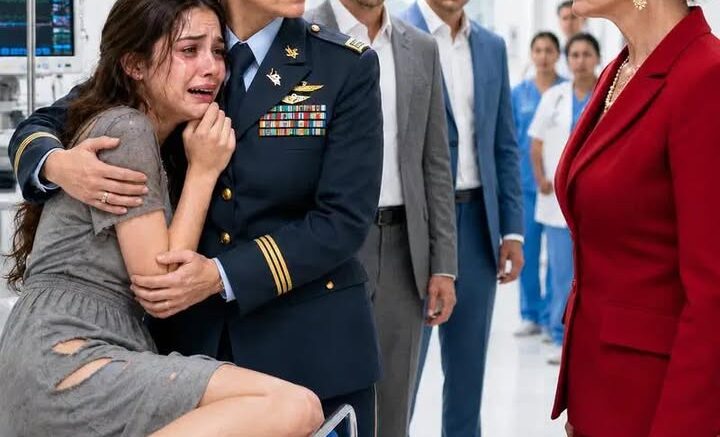
The sun was setting over North Carolina, casting long, amber shadows across the asphalt as I sped away from Fort Liberty. I was still wearing my Class A uniform, the fabric stiff and formal against my skin. My black dress jacket was sharply pressed, a testament to decades of discipline, and the rows of ribbons and medals pinned across my chest caught the dying light like shards of cold steel.
On my right chest, the gold nameplate read: COLONEL VICTORIA HART. To the world, that name represented thirty years of tactical expertise, command authority, and unwavering service to the United States Army. But as I gripped the steering wheel, my knuckles white with tension, I wasn’t thinking about logistics or maneuvers. I was a mother responding to a distress call that had chilled my blood.
“Mom, please come get me… my husband’s family harmed me.” The words had been a ragged whisper over the phone, followed by the sound of a line cutting to static. I didn’t call the police first; I knew who we were dealing with. I drove toward Mercy General Hospital in Charlotte with a singular, burning focus: Find my daughter.
When I marched through the emergency room doors, the atmosphere shifted. The frantic energy of the triage area seemed to stall as I crossed the linoleum floor. A young nurse, startled by the sight of a high-ranking officer appearing like a storm cloud in the lobby, quickly stepped into my path to block my progress.
“Ma’am, I’m sorry, you can’t go back there without authorization,” she began, her voice wavering. I didn’t break my stride, my eyes locking onto hers with the intensity of a battlefield briefing. The authority I carried wasn’t just in the silver eagles on my shoulders; it was in the marrow of my bones.
“My daughter,” I said, my voice low and dangerously steady. “Where is Emily Hart?” The nurse studied my face for a split second, seeing the raw desperation masked by military stoicism. Without another word, she quietly stepped aside and pointed toward the specialized observation wing.
I found Emily at the very end of the hallway, tucked away in a small, dim room that felt more like a cage than a place of healing. She was curled into a tight ball beneath a thin, scratchy hospital blanket, looking smaller than I had ever seen her. She was pale, her breathing shallow and rhythmic, as if she were trying to disappear into the mattress.
As I stepped closer, the damage became visible. Her face was swollen, her skin marked by the telltale signs of physical struggle. Her arms, once so full of life, showed the dark bruising of rough handling. Even her white designer dress—a gift from her new family—was torn at the shoulder and stained with the grim reality of the evening.
This was my beautiful daughter. This was the same little girl who used to call me every single night during my three deployments to the Middle East, just to describe the colors of the sunset so I wouldn’t forget what home looked like. She was the light that had kept me going through the darkest nights of my career.
She was the same girl who had once spent weeks drawing pictures for the soldiers in my unit, taping them to our refrigerator with pride when I finally returned. She was kind, gentle, and perhaps too trusting of a world that didn’t deserve her grace. Now, she could barely raise her head to look at me.
“Mom…” she whispered, her voice breaking on the single syllable. The sound pierced through my professional exterior, reaching the primal core of my heart. I crossed the room in two steps, pulling her into my arms and shielding her from the cold air of the hospital room.
Her whole body trembled against me, shaking with the kind of deep-seated terror one only sees in a frightened child. I held her, stroking her hair and whispering that I was there, that the cavalry had arrived. But the moment of peace was shattered by a sound that made my skin crawl: the sound of casual, dismissive laughter.
Be the first to comment on "The Colonel’s Command: When Power Meets a Mother’s Vengeance"