
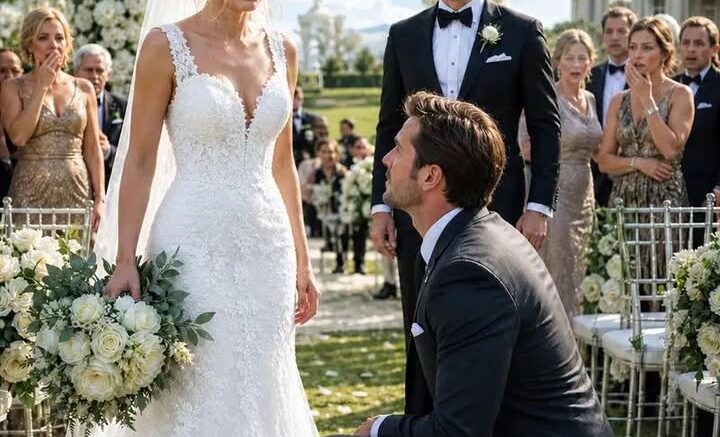
The morning I was supposed to become Mrs. Alexander Whitmore, my mother struck me across the face in the bridal suite. It wasn’t a blow intended to leave a bruise that makeup couldn’t camouflage, but it was delivered with enough force to suck the oxygen out of the room. My bridesmaids stood like statues, their breath hitching in unison as the sound of the slap echoed against the marble walls. My mother’s diamond bracelet trembled on her wrist, a shimmering reminder of the world we occupied.
“Do not embarrass this family,” she hissed, her voice a low, dangerous vibration. “Not today. Not ever.” I stood motionless before the floor-to-ceiling mirror, draped in a wedding gown that cost more than most people’s homes. My hands rested calmly at my sides, my pulse steady despite the sting on my cheek. Outside the tall windows of the Whitmore estate, six hundred white roses bowed against the Virginia wind, and a string quartet tuned their instruments under a tent the size of a cathedral.
Two families worth billions were gathered below, sipping vintage champagne and waiting to witness what the social registries had dubbed the ‘perfect marriage.’ That word, ‘perfect,’ had followed me since childhood like a shadow. I was the perfect daughter, the perfect heiress, and now, I was meant to be the perfect trophy wife. But that morning, I had committed the ultimate transgression in our world: I had told my fiancé I was penniless.
I hadn’t lost the money to a bad investment or a scandal. I had told Alexander that I had walked away from my trust fund, my inheritance, and my shares in my father’s global empire. I told him I wanted to know if he would still marry me if all I brought to the altar was my soul and my name. The transformation of his face was instantaneous; the charming mask he wore for the world didn’t just slip—it shattered. He didn’t offer comfort or ask for an explanation; he simply turned his back and walked out of the room.
Twenty minutes later, my mother had stormed in, her eyes cold enough to freeze the floral arrangements. She demanded to know what I had said to provoke him, and when I told her the truth, the room turned glacial. My maid of honor, Claire, stared at the floor, while my cousins looked at me as if I had just set the estate on fire. My mother stepped closer, her voice trembling with a mixture of rage and desperation.
“You are playing a dangerous little game, Serafina,” she warned. I looked her in the eye, seeing not a mother, but a woman terrified of losing her social standing. “No,” I replied softly. “I’m ending a game that should have never been played.” That was when she slapped me. For a fleeting second, I tasted the metallic tang of blood, a physical manifestation of the violence that hidden wealth can inflict on a family.
My father, Sterling Cross, appeared in the doorway then. A man who could silence entire boardrooms just by removing his glasses, he looked at my mother, then at my reddened cheek, and a flash of genuine shame crossed his features. “Vivian,” he said quietly, his voice carrying the weight of decades of unspoken regrets. “Enough.” But my mother was far from finished; to her, the loss of a strategic alliance was worse than the loss of a daughter.
“She is about to ruin everything,” my mother cried, gesturing wildly toward the window where the guests were beginning to take their seats. I turned back to my reflection, my eyes bright but dry. I had spent years crying in private over men who looked at my face but saw only the digits in my bank account. “Everything?” I asked her. “Or everyone?” The silence that followed was the loudest sound in the room.
I knew exactly what they feared. It wasn’t my heartbreak or the potential for my future unhappiness. They feared the scandal, the cameras, and the whispers that would echo through the country clubs for years to come. They feared the headline: ‘Cross Heiress Dumped at the Altar.’ But I feared something far more permanent: I feared spending forty years tied to a man who only loved the ink on my birth certificate.
Alexander Whitmore had been the consummate suitor. He was tall, polished, and possessed a smile that made older women forgive his arrogance and younger women mistake it for character. He was a master of the small details, the handwritten notes, and the grand gestures. He looked at me like I was a rare treasure, and for a long time, I let myself believe that the treasure he saw was me.
However, the cracks had begun to show months ago. Our romantic dinners eventually turned into interrogations about asset management and trust structures. He wanted to know if my father had updated his will and if I would consider merging my holdings with his family’s investment firm. Every conversation felt like a transaction, a vulture circling a body, waiting for the right moment to strike.
So, I decided to test the foundation of our life together. I told him I had donated my wealth to charity and intended to live a simple life away from the Cross name. He laughed at first, thinking it was a joke. Then he became irritated, then cold, and finally, that morning, he looked at me with a disgust so profound it was as if I had become physically repulsive to him.
Be the first to comment on "The Price of a Name: Why I Let My Fiancé Leave Me at the Altar"