
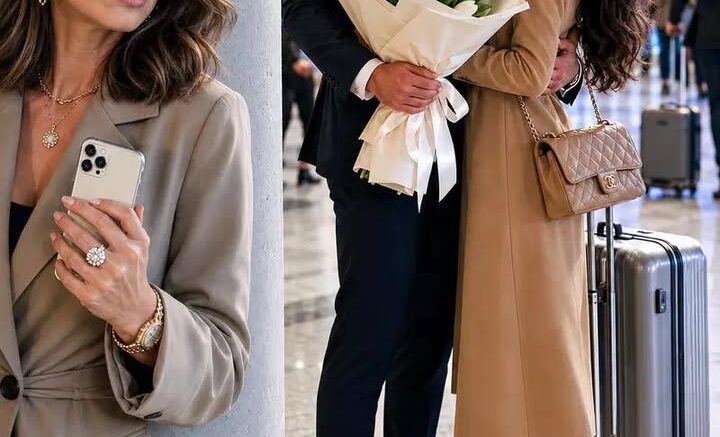
The realization that my marriage had reached its expiration date didn’t come with a dramatic confrontation or a tearful discovery of a hidden letter. Instead, it arrived in the sterile, echoing expanse of the Dallas/Fort Worth International Airport, as I stood concealed behind a cold concrete pillar. I wasn’t there to spy, yet fate had placed me in the exact coordinates necessary to witness the unraveling of my life. It wasn’t the sight of another woman that broke me; it was the expression on my husband’s face—a look of radiant, genuine joy that had been absent from our home for nearly a decade.
My phone vibrated in my palm, a stark contrast to the hollow silence in my chest. The message was from Ethan: “Keep tomorrow evening free, Madison. I have something special planned. I want you to feel like the most important woman in my world.” I stared at the words, the irony tasting like ash. Twenty feet away, the man who sent that text—Dr. Ethan Carter, a man whose reputation for saving hearts was as pristine as his surgical scrubs—stood waiting by the arrivals gate with a devotion that felt like a physical blow.
In his hands, he clutched a bouquet of white tulips. To a casual observer, it was a romantic gesture. To me, it was a forensic piece of evidence. Throughout our fifteen years of marriage, Ethan had weaponized pragmatism against any form of sentimentality. He famously labeled floral arrangements as “financially irresponsible” and “biologically decaying waste.” On our last anniversary, he had gifted me a high-end smartwatch, not as a token of affection, but as a tool to “optimize my daily efficiency.”
But these tulips were different. They weren’t the hurried, plastic-wrapped variety one grabs from a grocery store in a fit of guilt. These were premium blooms, expertly curated and wrapped in heavy cream paper, secured with a hand-tied satin ribbon. They were the product of a high-end florist and a significant amount of forethought. As the owner of a luxury event design firm, I know the language of flowers intimately. These tulips weren’t a gift; they were a tribute.
Then, she emerged from the terminal. Sophia Bennett was the embodiment of effortless sophistication, moving through the crowded airport with a grace that turned heads. Her camel-colored wool coat was draped perfectly over her shoulders, and she navigated her designer luggage with the confidence of someone who knew exactly where she was going and who was waiting for her. I recognized her instantly from the numerous medical technology galas and donor dinners I had organized for Ethan’s hospital.
For months, I had questioned the frequency of their “professional” interactions. Every time I mentioned the palpable chemistry between them at charity events, Ethan would retreat into a fortress of gaslighting. He called me paranoid. He told me I was imagining things. He suggested that my high-stress career was finally making me lose my grip on reality. But as she approached him, the lie disintegrated. The way her face ignited with a private, glowing warmth was a truth no argument could dismiss.
Ethan didn’t just greet her; he came alive. It was a transformation that felt like a betrayal of every quiet, lonely evening I had spent wondering what I had done wrong. He lifted the bouquet, and she stepped into his embrace with the practiced ease of a woman coming home. There was no hesitation, no social awkwardness of colleagues meeting after a flight. It was an intimate, synchronized movement—the kind of hug that is only possible after a thousand rehearsals in the dark.
I stood paralyzed, the rushing tide of travelers becoming a blurred smear of color around me. The airport’s overhead announcements faded into a dull hum, replaced by the deafening thrum of my own heartbeat. I waited for the stereotypical reaction—the urge to scream, the stinging heat of tears, the impulse to storm forward and cause a scene that would make the evening news. But those emotions never arrived. Instead, a profound, icy clarity settled over me.
Certainty is a powerful sedative. In that moment, the confusion that had plagued my marriage for years vanished. I watched as Ethan whispered something into her ear, causing her to let out a soft, melodic laugh against his shoulder. He then took the handle of her suitcase with a protective, second-nature gallantry he hadn’t shown me since our honeymoon. I wasn’t just watching a husband cheat; I was watching a man who had already moved on and simply forgotten to tell me.
I looked down at my phone again, re-reading his promise to make me feel like the “most important woman in his world.” The strategy was clear: he was planning to use the upcoming Whitestone Medical Foundation gala as a stage for a grand, hollow gesture. He wanted to perform the role of the devoted husband one last time to secure his social and professional standing before making his exit. He thought he was the director of this play, and I was merely a prop.
What Ethan failed to remember is that I have spent fifteen years building flawless illusions for the most powerful people in Texas. I have managed crises that would break most men, and I have orchestrated events where every single detail—from the lighting to the seating chart—is a calculated move. I didn’t need to scream in an airport terminal. I didn’t need to cry. I had a gala to attend, and for the first time in my career, I was going to design an event that was entirely for myself.
I quietly turned away, blending into the crowd of arriving passengers. I walked toward the parking garage with a steady stride, my mind already cataloging the resources at my disposal. Ethan believed he was in control because he held the flowers, but he had forgotten who built the garden. The most dangerous person in any room isn’t the one who is loud; it’s the one who is silent, observant, and already three steps ahead of the game.
Be the first to comment on "The Architect of the Aftermath: A Lesson in Composure and Consequence"