
The tension in the Whitmore dining room was thick enough to cut with a dull knife, heavier than the scent of roasted turkey and sage stuffing. It was a scene I had endured for years: a room full of people who viewed my presence as a temporary inconvenience. This Thanksgiving, however, the air felt different. It felt like a trap waiting to spring.
After a brutal confrontation at the table, the entire room turned against me. My husband, Daniel, the man who was supposed to be my partner and protector, stood among them with a face like flint. He didn’t reach for my hand or try to bridge the gap. Instead, he delivered a cold, public ultimatum that shattered the last remnants of our marriage: “Say you’re sorry, Emily, or pack your things and leave.”
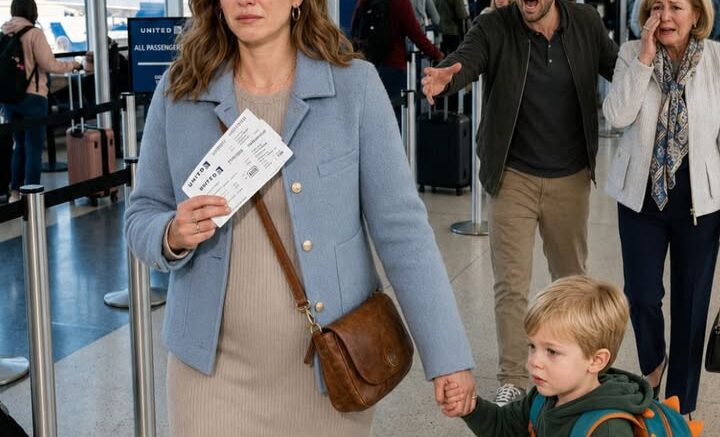
I looked at him, truly seeing him for the first time in a decade, and I realized I didn’t want to be sorry anymore. So, I did exactly what he asked. I chose the latter. I walked out of that house, packed two suitcases, woke our three-year-old son, and bought two one-way tickets to a new life. By the time the Whitmores realized we were gone, I had already sent the evidence that would dismantle their carefully constructed lies.
It all began, quite ironically, with the cranberry stuffing. We had traveled to Ohio for the holiday, returning to the ancestral seat of the Whitmore family—a house filled with framed photos of people who looked perfect and voices that treated verbal assault as casual conversation. It was a place where I was always the outsider.
From the moment we arrived, I was on high alert. My son, Noah, was at that curious, kinetic age of three where every heirloom is a target. The house was a minefield of breakable crystal and steaming platters. While the rest of the family lounged with wine, I was the sole sentry, keeping Noah away from his grandfather’s unlocked case of antique knives—a hazard everyone else treated as a charming quirk.
My mother-in-law, Patricia, was the architect of my misery. From our very first meeting, she had signaled that I was an interloper. In her eyes, I was far too independent, too career-driven, and far too quiet to be the submissive accessory she envisioned for her son. She viewed my professional success not as a contribution, but as a slight against her son’s masculinity.
That afternoon, once the family was assembled around the mahogany table, Patricia decided it was time for the main course: my character assassination. She leaned in with a smile that never reached her eyes and asked, “So, Emily, are you still sending Noah to that daycare? I’ve always told Daniel a child needs his mother, not strangers raising him.”
The table fell into a deafening silence. I looked to Daniel, expecting a defense, a deflection, or even a simple request to change the subject. He did nothing. He stared intently at his mashed potatoes, his silence serving as a silent endorsement of his mother’s cruelty.
“I work because I need to, Patricia,” I replied, my voice steady despite the hammering in my chest. “And because I choose to. I find fulfillment in my career, and Noah is thriving in a social environment.”
Patricia let out a sharp, mocking laugh that echoed off the high ceilings. “Choose to. That says everything, doesn’t it? You’ve always been someone who puts herself first, regardless of the cost to the family unit.”
Daniel’s brother, Mark, snickered into his napkin. His wife, Lacey, leaned over to whisper something to their teenage daughter, who giggled under her breath. I felt the heat rising in my neck, the familiar sting of being the family punching bag while my husband played the role of the grieving bystander.
“I pay half the mortgage,” I said, the words spilling out before I could stop them. “I pay for that daycare you despise. I even paid off Daniel’s secret credit card debt last year to keep us afloat. I am the reason this family has a safety net.”
Be the first to comment on "The Thanksgiving Ultimatum: Why I Packed My Bags and Never Looked Back"