
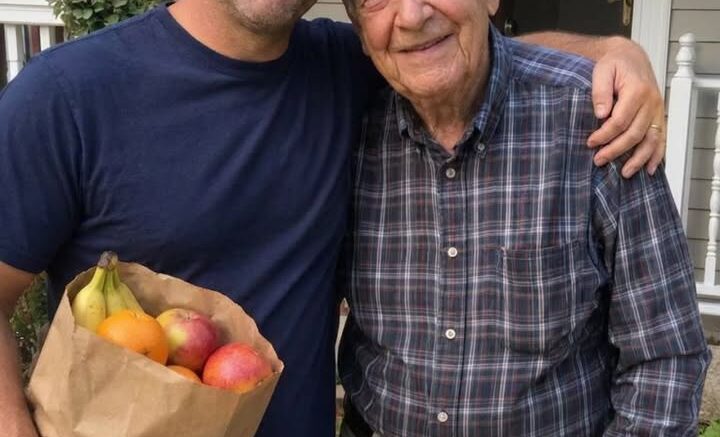
For twelve years, my Sunday mornings followed a rhythm as predictable as the sunrise. It wasn’t a religious obligation, but it was a sacred one nonetheless. Every week, without fail, I would navigate the aisles of the local market, selecting the same specific brands of oats, tea, and marmalade that I knew my neighbor, Ezra Harrison, preferred. What started as a simple act of neighborly kindness evolved into the cornerstone of my week, a quiet bridge between two generations.
Ezra had lived in the house adjacent to mine for as long as I could remember. In the early days, our relationship was defined by the polite, distant boundaries of suburban living. We were the kind of neighbors who exchanged rhythmic waves from our respective driveways and shared superficial remarks about the weather. He was a fixture of the street, yet he remained a complete mystery to me, a man whose history was tucked away behind the lace curtains of his modest home.
The shift occurred on a blistering Sunday afternoon when I noticed Ezra fumbling with a heavy paper bag. His eighty-year-old frame seemed to buckle under the weight of a few cartons of milk and a loaf of bread. Instinct took over; I crossed the lawn before I even realized I was moving, catching the bag just as the bottom began to give way. The gratitude in his eyes was immediate, though shadowed by a flicker of pride that didn’t want to admit he needed the help.
To express his thanks, he invited me inside for a cup of coffee. At that moment, I had a dozen other things I could have been doing—errands to run, chores to finish, or simply relaxing in front of the television. However, something in his posture, a certain quiet loneliness, made me pause. I accepted the invitation, stepping across a threshold I hadn’t realized would become so familiar over the next decade.
We sat at his small kitchen table, the air smelling of old paper and peppermint tea. That first hour-long conversation was a revelation. Ezra wasn’t just a retiree; he was a storyteller with a mind that remained sharp despite his slowing gait. We talked about how the neighborhood had changed since the sixties, the rise and fall of local businesses, and the simple beauty of a well-tended garden. As I stood to leave, I jokingly told him to call me before his next grocery run so I could handle the heavy lifting.
Neither of us could have predicted that a casual jest would solidify into a twelve-year tradition. As time marched on, the natural erosion of age began to take its toll on Ezra. His eyesight dimmed, and his reflexes slowed, making the act of driving a dangerous proposition. Without fanfare, I officially took over his weekly shopping. It became our unspoken agreement, a weekly contract signed in kindness and delivered in brown paper bags.
In the beginning, Ezra was adamant about reimbursement. He would produce a worn leather wallet, his fingers trembling as he tried to count out the exact change. I always pushed his hand back, insisting that the pleasure of his company was payment enough. Eventually, he stopped offering the money, perhaps realizing that my refusal wasn’t about charity, but about a growing bond that transcended mere transactions.
Our Sunday sessions became the highlight of my week. After putting the groceries away—milk in the back of the fridge, bread on the counter—we would settle into our routine. These were the moments where the true exchange happened. He would share fragments of his past: his years working as a craftsman, the wife he had lost too soon, and the dreams he had harbored in his youth. In return, I found myself opening up about my own life, my career anxieties, and my personal milestones.
We spoke of profound things, and we spoke of nothing at all. There were Sundays where we sat in comfortable silence, watching the birds congregate at the feeder outside his window. These hours taught me the value of presence—that simply being there for another human being is one of the most significant gifts we can offer. Ezra became more than a neighbor; he became a surrogate grandfather, a silent witness to my own life’s progression.
However, the passage of time is an indifferent thief. As Ezra reached his eighty-fourth year, I noticed he was growing frailer. The walks from the door to the table took longer, and his voice, once resonant, had thinned to a soft rasp. Yet, his spirit remained undiminished. He never complained about his mounting aches or the narrowing of his world; he only expressed gratitude for the sun on his face and the tea in his cup.
One crisp Monday morning, I pulled out of my driveway and noticed something was wrong. Ezra’s porch light, which he always extinguished the moment he woke, was still burning bright against the morning sun. A cold knot of dread formed in my stomach. I knocked, but there was no answer. By noon, the paramedics confirmed what I already feared: Ezra had passed away peacefully in his sleep, his long journey finally coming to a quiet end.
His funeral was a somber, intimate affair. I was surprised to see how few people were in attendance. For a man who had lived such a long and rich life, the pews were largely empty, occupied only by a handful of distant relatives and a few old acquaintances. It reinforced the quiet, solitary nature of the life he had led in those final years. As the service concluded, I felt a profound sense of loss, as if a library had burned down and I was the only one who remembered the books.
Be the first to comment on "The Sunday Ritual: A Legacy Hidden in a Battered Suitcase"