
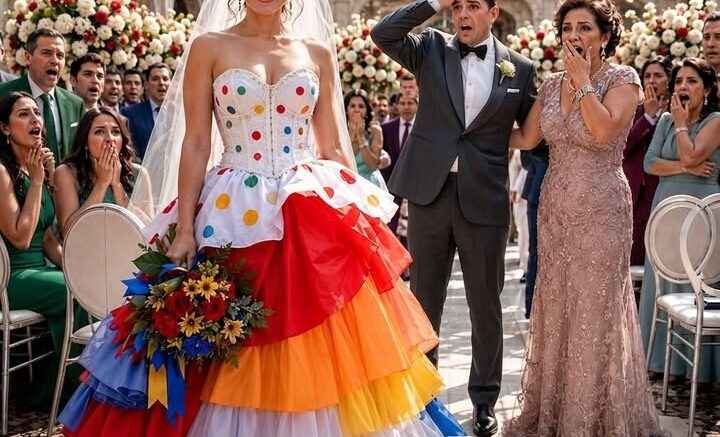
The first thing I saw on my wedding morning was not the delicate lace of my custom ivory gown, but a garish red foam nose sitting mockingly where my silk veil should have been. Beneath it lay a striped, polyester clown costume, crumpled like a discarded joke. Tucked into the folds was a note in my mother-in-law’s sharp, unmistakable handwriting: “Know your place.”
For ten agonizing seconds, the bridal suite was silent, save for the rhythmic tapping of rain against the grand windows of Whitmore Hall. My bridesmaids froze behind me, their champagne smiles draining away into expressions of pure horror. The air felt thick with the weight of a cruelty so calculated it felt theatrical.
My father, standing near the door in his charcoal suit, looked at the empty mannequin where my dress had hung just an hour earlier. The silk was gone, replaced by this cheap, primary-colored mockery. He took a step toward me, his face a mask of concern and rising fury.
“Clara,” he said softly, his voice trembling with a protective instinct he had carried since I was a child. “You don’t have to do this. We can leave right now. We can walk out the back door and never look at this family again.”
Downstairs, two hundred guests waited under crystal chandeliers, sipping vintage wine and whispering about the union of the Whitmore legacy. My fiancé, Bennett Whitmore, waited at the altar, polished and handsome, the golden child of a family that treated kindness like poverty and poverty like a contagious disease.
His mother, Elise, had never forgiven me for being “ordinary.” That was her favorite word for me. She had whispered it at engagement dinners, mouthed it at charity luncheons, and even sighed it during our cake tastings. To her, I was an interloper, a commoner who had tricked her son into a lapse of judgment.
“She’ll learn,” Elise had once told Bennett, unaware that I could hear her from the hallway of their estate. “Girls like her always do. They eventually realize they are just a footnote in a much grander story.”
Bennett had laughed. It wasn’t a cruel laugh, perhaps, but it was a compliant one. It was the sound of a man who would always choose his mother’s approval over my dignity. That laugh was the exact reason I did not cry as I looked at the yellow buttons and oversized sleeves.
One of my bridesmaids whispered, her voice frantic, “Call security. Call the police. Call Bennett. He has to know what she’s done. She’s stolen a ten-thousand-dollar dress, Clara!”
“No,” I said, my voice sounding strangely calm even to my own ears. I realized in that moment that Elise didn’t just want to ruin my wedding; she wanted to break my spirit. She wanted me to hide, to collapse, to give her a story of a ‘hysterical’ girl she could retell for years at her garden parties.
I could already hear her voice: ‘Poor Clara. So unstable. So dramatic. We tried to welcome her, but she simply wasn’t fit for our family.’ If I didn’t show up, she won. If I showed up crying, she won.
My father’s jaw tightened as he watched me reach for the costume. “Sweetheart, tell me what you want. Whatever you choose, I am right here.” I looked at him in the mirror, then I looked at the small black folder tucked inside my bridal clutch—the one Elise had dismissed as a “cute little wedding planner.”
Be the first to comment on "The Bride in the Red Nose: Why I Wore a Clown Costume to My Own Wedding"