
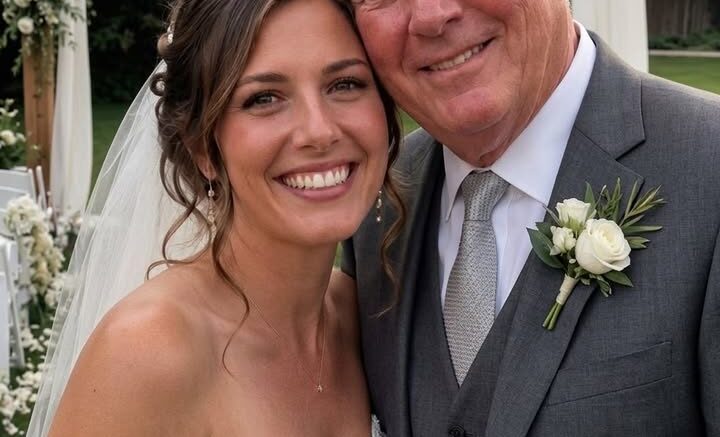
The whispers began the moment I stepped into Russell’s world, a soft hiss of judgment that followed me like the train of a wedding dress I hadn’t quite earned. To the outside observer, the math was simple and cynical: I was thirty-two, he was sixty-two, and his bank account had more zeros than my life had prospects. They saw a transaction, a cold-blooded exchange of youth for security, and in the beginning, I lacked the energy to prove them wrong.
I was drowning when I met him, suffocating under a mountain of debt and the relentless pressure of living paycheck to paycheck. Every ringing phone was a debt collector; every envelope in the mail was a threat. I was a woman who had forgotten what it felt like to breathe without a weight on her chest, serving champagne to people who spent my annual salary on a single watch.
Russell was different from the others at that charity gala. He didn’t look through me as if I were part of the furniture. Instead, he looked at me with a tired, gentle curiosity that caught me off guard. He didn’t ask for my number or offer a sleazy compliment; he simply asked my name and then, with genuine concern, asked if my feet hurt from standing all night.
It was such a human question in such an inhumane environment that it shattered my defenses. No one had cared about my physical comfort in years. That simple inquiry was the seed of something I couldn’t yet define, a moment of recognition between two people who were, in their own ways, profoundly isolated from the world around them.
When he proposed three months later, the world exploded in a chorus of condemnation. My friends warned me I was throwing my life away on a man who would soon be a memory, while his adult children treated me like a virus that had infected their father’s legacy. They saw me as a predator, a gold-digger who had successfully trapped a lonely widower in her web.
His daughter, Elena, was the most vocal of the group. On our wedding day, amidst the scent of expensive lilies and the glow of crystal chandeliers, she cornered me in the hallway. Her voice was a sharp blade, cutting through my fragile composure as she hissed that I would never see a dime of the family estate. She promised me that I would end up with nothing.
Russell had been standing just around the corner, his presence quiet but commanding. He didn’t erupt in anger or defend me with grand gestures. He simply walked over, placed a hand on my shoulder, and looked his daughter in the eye. With a calm, unsettling smile, he told her, “Don’t worry, Elena. She will get exactly what she deserves.”
I took those words as a warning, a reminder that even in my new life of luxury, I was a guest. I told myself that the comfort was enough. The heated floors, the quiet mornings spent in a sun-drenched library, and the absence of financial terror were the prizes I had won. I convinced myself that I was satisfied with the arrangement, a quiet life for a quiet price.
But the human heart is a treacherous thing, prone to growing in directions we never intended. Somewhere between the shared cups of tea and the long walks through his gardens, the pretense began to slip. I stopped seeing a benefactor and started seeing a man who was brilliant, funny, and deeply vulnerable. I found myself caring for him in a way that was both inconvenient and terrifying.
I no longer needed to pretend I was happy; I actually was. For the first time in my life, I felt seen, not as a decorative object or a service worker, but as a partner. Russell didn’t just give me his money; he gave me his time, his stories, and a sense of belonging that I had never experienced in my own broken family.
Then, the sky fell. The diagnosis was a sudden, violent intrusion into our peaceful life. Cancer is a thief that doesn’t care about wealth or happiness. It moved through him with a terrifying speed, turning a vibrant man into a shadow in a matter of weeks. From the first scan to the final breath, I barely had time to process that my world was ending.
At the funeral, the air was thick with a tension that rivaled the grief. His children stood across the grave from me, their faces masked in stony indifference, looking at me as if I were a squatter they were waiting to evict. I wept openly, not for the loss of the house or the status, but for the loss of the only man who had ever asked if my feet hurt.
Be the first to comment on "What I Deserved: The Unexpected Legacy of a Thirty-Year Gap"